Expansion of the communications network (5G, 6G)

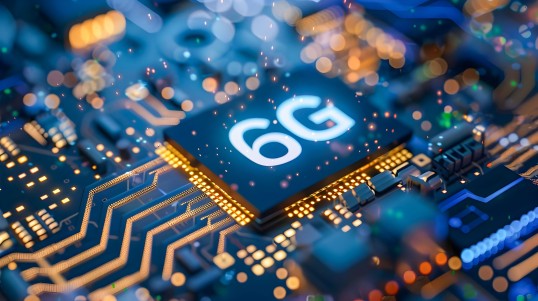
6g Chip on Circuit Board

Source: Intrpohn - stock.adobe.com

Communication systems are the "central nervous system" of a digital world and form the basis for innovative technologies such as artificial intelligence (AI), networked control systems and robots, self-driving (autonomous) vehicles, and augmented and virtual realities (AR, VR). These technologies create opportunities for society and are crucial to the future competitiveness of Germany and Europe.

Information can be transmitted over wired connections (e.g. fibre-optic cables, copper wires) or wirelessly by mobile or satellite communications. In Germany, the mobile communications (telephony) network is to be further expanded and upgraded, including by the increased use of satellites [1]. 5G is the mobile communications standard of the current generation in 2025. 5G is currently being expanded worldwide and is already available in many regions and cities in Germany [2], covering a total of 92% of the country [3]. 6G is currently the subject of research and will not become available for some time.

5G is already intended to permit communication in real time. However, owing to the continual rise in the number of applications handling enormous volumes of data, 5G will reach its limits when infrastructures and networks are to be created capable of transferring hundreds of gigabits per second, and with extremely low latency.

6G technology is expected to attain fifty times the data transmission rate and one-tenth of the latency of 5G, thereby permitting the transmission of huge volumes of data for collective or networked intelligence. In the future, this will expand the range of applications for technologies such as AR, VR, the tactile Internet (metaverse), teleoperation and autonomous driving. 6G will also support holographic communication, intelligent networks and the merging of different network types (e.g. telephony, video, data). The aim is to create an almost direct and comprehensive link between people and the physical and digital worlds, and thereby improve interaction between them [4]. Finally, 6G is important for the further development of modern technologies such as deep learning, big data, edge computing and the Internet of Things (IoT) [5], and furthers, for example, the use of digital twins and medical imaging. In conjunction with AI, the technology will be capable of reaching autonomous decisions regarding data management and use [6].


  • What is accelerating this development, and what is slowing it down?

    A fibre-optic network is the indispensable basic infrastructure for future mobile communications networks. Germany is to be equipped nationwide with such networks by 2030. This is to be assured by political initiatives and subsidy schemes, such as the German government’s "Gigabit Strategy" [7], together with simplified approval procedures and the coupling of frequency allocations to obligations to upgrade the infrastructure.

    A recent discussion paper [8] presented by the German Federal Network Agency (BNetzA) sets out the structure for the process of migration from copper to fibre-optic network. However, the distribution of costs and the handling of areas served by third-party infrastructure have yet to be clarified and could be an obstacle to decommissioning of the copper network.

    Innovative technologies such as small mobile phone cells (small cells [9]) are conducive to this trend; infrastructure sharing [10] between network operators during mast and site construction also saves time and reduces costs. In addition, digital tools exist for accelerated approval and planning procedures and swifter identification of dead zones [11].

    Information and communication systems are part of critical infrastructure: their development and constant availability are therefore strategic goals. Germany plans to take a leading role in the market launch of 6G in 2030 [12]. The German Platform for Future Communication Technologies and 6G (6G Platform), launched in 2021 by the German Federal Ministry of Education and Research (BMBF) [13], supports this goal by sponsoring innovation and creating a network of stakeholders such as research institutions and industrial and policymaking bodies, in order to facilitate cooperation in the development of 6G technologies. The Hexa-X project funded by the European Union pursues the same goal [14].

    The availability of data in the right place, at the right time assures the competitiveness of the German economy. High-performance mobile networks, in particular, are crucial for connectivity, as they also enable small and medium-sized enterprises (SMEs) in Germany to compete on the global market. The study entitled "Alles vernetzt, alles möglich" (everything connected, everything possible) conducted by VDI/VDE Innovation + Technik GmbH and the Institute of Economic Structures Research (GWS) anticipates significant positive economic effects by 2050, particularly from the 6G transmission standard [15].

    The EU’s IRIS2 program aims to complement the European communications network with secure satellite infrastructure by 2027, not least to support and further digitally develop the areas of surveillance (e.g. border surveillance), crisis management (e.g. humanitarian aid), connectivity and protection of important infrastructures (e.g. secure communications for EU embassies) in view of the changed global situation. This will improve network coverage, increase reliability and enhance Europe’s digital sovereignty [16].

    Against the backdrop of calls for climate change mitigation and sustainability, the 6G standard in particular has the potential to conserve material, energy and time resources and make processes more climate-friendly. For example, the SUSTAIN-6G project (Horizon Europe Lighthouse) is studying how 6G technologies can be used for climate-neutral and more resilient power grids, better healthcare and environmentally compatible agriculture [17].

    Furthermore, the shortage of skilled workers and other personnel, especially in the social professions, requires the development of 6G to be accelerated. Intelligent assistive robots are expected to support society in many areas, for example in nursing homes and hospitals [18]. In many other sectors (construction, agriculture, plant and machine construction, healthcare, etc.), 5G/6G networks permit digital solutions that can compensate for the shortage of skilled workers. At the same time, the shortage of skilled workers in the areas of planning, approval and construction presents a potential obstacle to expansion of the 5G/6G network.

    Other aspects, however, may also slow down the further development and expansion of the communications network, either directly or indirectly. These include lengthy approval procedures for new mobile phone masts and antennas, complex regulations concerning construction, environmental protection and listed buildings, resistance from residents, legal objections, and aspects of cost and economic viability, such the high cost of investment, operation and terminal devices for 5G [19].

    Even though 6G, in particular, can contribute to climate change mitigation in the longer term, it is also conceivable that endeavours for the purposes of sustainability will slow down the rollout of 6G, as they lead to stricter requirements for energy consumption, resource extraction and recycling. This may check the process but will at the same time ensure a higher-quality and more sustainable mobile communications standard.

  • Who is affected?

    The use of AI applications in networked systems is dependent upon cutting-edge mobile communications standards. Expansion of the mobile communications network therefore indirectly affects all employees (e.g. in monitoring and production), but primarily those working in the field of new 5G/6G technology products. However, it will also increasingly affect sectors in the service industry, for example in relation to driverless means of transport or intelligent assistive robots in nursing homes and hospitals [18]. The following industries and sectors are particularly affected: agriculture and forestry, the automotive industry, aviation, catering and service staff, the chemical industry, civil engineering and associated demolition, the construction sector, the healthcare sector, information and communications technology (ICT), logistics, manufacturing, media production, metal structure construction, metalworking, mobility, plant and machine construction, plastics and rubber goods, port and waterway construction, plumbing, heating and air conditioning, the power generation industry, printing and paper processing, rail transport, road passenger transport, road freight transport.

  • Examples (in German only)
  • What do these developments mean for workers’ safety and health?

    The digital innovations made possible by modern mobile communications standards, and their blanket availability offer potential benefits for occupational safety and health: work tasks can be simplified, dangerous work automated and processes better monitored. For example, a digitalized construction site provides intelligent connectivity between cranes, excavators and many other construction machines. Self-learning cameras and sensors permit a new construction process that reduces construction time and lowers the risk of accidents. Drones can provide support when used to monitor construction sites, for example, or to carry out site transport tasks, fit insulation or spray façades [20].

    The significant increase in the data transmission rate also permits applications in which multiple protective devices within an industrial plant are networked. This enables hazards to be detected sooner and machines to be placed in a safe state more rapidly. In combination with timely warnings to workers and persons responsible for safety, this creates new ways of preventing occupational accidents in the future [21]. In the healthcare sector, 5G makes fast data transmission, remote operations and robot-assisted care possible, thereby not only improving the provision of care, but also alleviating the shortage of nursing staff and reducing the workload of existing staff [22].

    Intelligent antennas are used in public 5G mobile communications systems. These enable the radiated power to be directed more precisely, by a process termed “beamforming”. This reduces the unfocussed power output into the environment, in turn reducing exposure levels [23]. At the higher frequencies, i.e. including those used in 6G, the use of such antennas will be indispensable for optimization of the data transmission range.

    The increasing vulnerability of networked systems in the event of faults or unauthorized hacking (cybercrime) presents an indirect hazard. The main factor here is the systems’ growing complexity, which in turn makes them more susceptible to faults and more difficult to monitor. In addition, the higher speeds of modern networks enable hackers to attack more devices and launch cyber-attacks on a wider scale. At the same time, 5G provides greater protection against hacking, as data is better encrypted and users are better verified [24].

    Rising connectivity leads to an increase in monitoring tasks, which reduces manual labour. This can lead to mental and physical stress (the latter owing to reduced physical movement) for workers and have a negative impact on their health. At the same time, increased connectivity opens up new opportunities for education, further training and exchange of knowledge. This makes it easier for workers to engage in lifelong learning, without being limited by constraints of time or location [25].

    The current state of scientific knowledge does not indicate any health risks from electromagnetic fields (EMFs), regardless of the technology used, provided the limit values are observed [26]. However, persons working directly on the infrastructure may face higher levels of exposure [21]. During installation and maintenance, hazards arise for employees in the proximity of high-frequency radiation sources. This requires the use of protective measures; these are, however, already well established. 6G will be the first technology to use frequencies in the terahertz spectrum, which could make the issue of impacts upon health again topical. The use of surfaces that amplify electromagnetic signals – termed reconfigurable intelligent surfaces (RISs) [27] – to ensure adequate range, specifically for 6G, may also have an impact on workers’ exposure to EMFs.

    Changes in job requirements resulting from remote work, and the control of autonomous machines and systems, pose particular challenges to workers’ motivation and their ability to concentrate [25].

    Expansion of the infrastructure for 5G and 6G requires more work to be performed on site, for example during the erection of antennas, laying of cables and performance of maintenance. This creates a heavier workload for workers and can increase the risk of occupational accidents (e.g. during work on electrical systems). In addition, workers require training to ensure that they are able to use the new technologies safely and recognize risks in time.

  • What observations have been made for occupational safety and health, and what is the out-look?
    • From an OSH perspective, the benefits for safety and health at work yielded by expansion of 5G/6G networks outweigh the drawbacks, as real-time communication and connectivity of sensor technology can help prevent accidents (e.g. by the use of wearables and remote monitoring of machines) or reduce the immediate presence of persons in high-risk workplaces (e.g. through robotics and remote control). In the future, high data transmission rates will also open up new possibilities for occupational safety and health in the area of training; an example is the use of VR simulations at multiple locations.
    • Digital innovations made possible in practice by the new network standards must be reviewed systematically for potentially adverse effects on workers.
    • The rollout of 5G and 6G is changing working conditions through the associated increase in work performed at great heights and the resulting risk of falls. Another focus is exposure to electromagnetic fields, particularly during work in close proximity to the technology. Suitable occupational safety and health concepts exist and, where necessary, must be implemented more widely or reviewed in consideration of new transmission systems such as beamforming antennas and reconfigurable intelligent surfaces (RISs).
    • Basic research into the effects of electromagnetic fields, particularly with regard to 6G’s terahertz spectrum, continues to be important.
    • The introduction of new technologies made possible by the new standards may initially give rise to hurdles in the area of training and adaptation. Training programmes are required, including for occupational safety and health reasons.
  • Sources (in German only)

    [1] Thomas Heyn, A. H.: Direkte Satellitenkonnektivität für 5G und 6G. Hrsg.: Fraunhofer-Institut für Integrierte Schaltungen IIS, Erlangen
    https://www.iis.fraunhofer.de/de/ff/kom/satkom/sat-5g.html

    [2] Woran erkenne ich, ob mein Smartphone im 5G-Netz funkt? Hrsg.: TECHBOOK.de Axel Springer Deutschland GmbH, 10888 Berlin 2023
    https://www.techbook.de/connectivity/mobilfunk/lte-4g-unterschied-mobil-smartphone (abgerufen am 20.11.)

    [3] 5G-Netzausbau. Hrsg.: Bundesministerium für Verkehr, Berlin 2024
    https://www.deutschland-spricht-ueber-5g.de/informieren/netzausbau/

    [4] Dhanasekaran, S.: Mit 6G zu einer nachhaltigeren Zukunft. Hrsg.: all-electronics, 69121 Heidelberg 2022
    https://www.all-electronics.de/elektronik-entwicklung/mit-6g-zu-einer-nachhaltigeren-zukunft-489.html (abgerufen am 19.03.)

    [5] Kugler, J.: 6G - Chancen und Herausforderungen. Hrsg.: Conntac GmbH, 86159 Augsburg 2024
    https://www.conntac.net/blog/6g-chancen-herausforderungen/ (abgerufen am 01.07.)

    [6] Vyas, M.: 6G und seine Potenziale. Hrsg.: WEKA Fachmedien GmbH, 85540 Haar 2023
    https://www.connect-professional.de/datacenter-verkabelung/6g-und-seine-potenziale.204480.html (abgerufen am 19.03.)

    [7] Die Gigabitförderung 2.0. Hrsg.: Bundesministerium für Verkehr, Berlin 2025
    https://www.bmv.de/Breitbandausbau

    [8] Bundesnetzagentur für Elektrizität, G.; Telekommunikation, P. u. E. R.: Impulse zur regulierten Kupfer-Glas-Migration. (2025)
    https://www.bundesnetzagentur.de/DE/Fachthemen/Telekommunikation/Kupfer-Glas/Impulspapier.pdf?__blob=publicationFile&v=3 (PDF, 675 KB, nicht barrierefrei)

    [9] Wie kleine Funkzellen in Städten das Netz stärken. Hrsg.: Bundesministerium für Verkehr, Berlin 2022
    https://www.deutschland-spricht-ueber-5g.de/magazin/wie-kleine-funkzellen-in-staedten-das-netz-staerken/#:~:text=Kleinzellen%20k%C3%B6nnen%20aufgrund%20ihrer%20geringeren,niedrig%20(siehe%20Infokasten%20unten

    [10] Infrastruktur-Sharing: Warum die Mobilfunkbetreiber bei der Nutzung von Standorten zusammenarbeiten. Hrsg.: Informationszentrum Mobilfunk GbR, Bonn 2023
    https://www.informationszentrum-mobilfunk.de/2023/10/30/infrastruktur-sharing-warum-die-mobilfunkbetreiber-bei-der-nutzung-von-standorten-zusammenarbeiten/

    [11] Bundesnetzagentur: Funklochkarte. Hrsg.: Bundesnetzagentur für Elektrizität, Gas, Telekommunikation, Post und Eisenbahnen, Bonn
    https://gigabitgrundbuch.bund.de/GIGA/DE/Funklochkarte/start.html

    [12] Kai Börner, M. R.-M.: 6G in die Anwendung bringen - Nachhaltige, resiliente und intelligente Vernetzung für Gesellschaft und Wirtschaft. Hrsg.: Bundesministerium für Forschung, Technologie und Raumfahrt, Bonn
    https://www.forschung-it-sicherheit-kommunikationssysteme.de/foerderung/bekanntmachungen/6g-a

    [13] 6G-Plattform. Hrsg.: Bundesministerium für Forschung, Technologie und Raumfahrt, Bonn
    https://www.forschung-it-sicherheit-kommunikationssysteme.de/projekte/6g-plattform

    [14] A holistic flagship towards the 6G network platform and system, to inspire digital transformation, for the world to act together in meeting needs in society and ecosystems with novel 6G services. (2025)

    [15] Kai Börner, J. P., Markus Schürholz, Britta Stöver, Julian Stubbe: ALLES VERNETZT, ALLES MÖGLICH - Wirtschaftliche Chancen für Industrie und Mittelstand in Deutschland durch 6G-Mobilfunk in Zeiten sich ändernder geopolitischer Rahmenbedingungen. (2025)

    [16] Bartel, M.: Souverän im Space. 2023 (2023), S. 38-51
    https://www.fraunhofer.de/s/ePaper/Magazin/2023/03/index.html#40 (nicht barrierefrei) (abgerufen am 19.09.2023)

    [17] Project, T. E. S. L.: SUSTainability Advanced and Innovative Networking with 6G. Hrsg.: Eurescom GmbH, Heidelberg
    https://sustain-6g.eu/

    [18] Galileo: 6G-Netz: Wann kommt der 5G-Nachfolger und was sind seine Vorteile? Hrsg.: Seven.One Entertainment Group GmbH, 85774 Unterföhring 2022
    https://www.prosieben.de/serien/galileo/news/6g-netz-mobilfunk-standard-definition-wann-der5g-nachfolger-kommt-vorteile-326918 (abgerufen am 19.03.)

    [19] Verkehr, B. f. D. u.: Auswertung der Konsultation "5G für die Wirtschaft: Wie verhelfen wir Schlüsseltechnologien wie 5G/6G in vertikalen Industrien zum Durchbruch?" (2025)

    [20] Wie wirkt sich 5G auf einzelne Branchen aus? Hrsg.: Bundesministerium für Verkehr, Berlin 2024
    https://www.deutschland-spricht-ueber-5g.de/informieren/wirtschaft/wie-wirkt-sich-5g-auf-einzelne-branchen-aus/

    [21] Werner, C.: 5G im industriellen Umfeld. (2024)
    https://www.ifa-handbuchdigital.de/ce/5g-im-industriellen-umfeld/detail.html (abgerufen am 12.2024)

    [22] Homrich, R.: 5G-Technologie - Welche Branchen und Unternehmen können wirklich profitieren? Hrsg.: NetMediaEurope Deutschland GmbH, 80331 München 2021
    https://www.zdnet.de/88397837/5g-technologie-welche-branchen-und-unternehmen-koennen-wirklich-profitieren/#

    [23] Was sind "intelligente Antennen" und welchen Einfluss hat deren Nutzung auf die elektromagnetischen Felder? Hrsg.: Bundesministerium für Umwelt, Klimaschutz, Naturschutz und nukleare Sicherheit (BMUKN), Berlin 2019
    https://www.bundesumweltministerium.de/faq/was-sind-intelligente-antennen-und-welchen-einfluss-hat-deren-nutzung-auf-die-elektromagnetischen-felder

    [24] Der neue 5G-Standard - Ein Paradies für Hacker. Hrsg.: IT Verlag für Informationstechnik GmbH, Otterfing 2019
    https://www.it-daily.net/it-sicherheit/cybercrime/der-neue-5g-standard-ein-paradies-fuer-hacker

    [25] Roscher, S.; Schiefer, C.; Wittlich, K.: Trendsuche der DGUV. Hrsg.: Deutsche Gesetzliche Unfallversicherung e. V. (DGUV), Verwaltungs-Berufsgenossenschaft (VBG), Berlin, Hamburg 2022
    https://publikationen.dguv.de/praevention/allgemeine-informationen/4566/trendsuche-der-dguv-2021?number=SW22211

    [26] Strahlung beim Mobilfunk: Was die Forschung bislang weiß. Hrsg.: Bundesministerium für Verkehr, Berlin 2024
    https://www.deutschland-spricht-ueber-5g.de/informieren/mobilfunkstrahlung-und-gesundheit/wissenschaft-transparent-gemacht/

    [27] 6G-LICRIS. Hrsg.: Bundesministerium für Forschung, Technologie und Raumfahrt, Bonn 2025
    https://www.forschung-it-sicherheit-kommunikationssysteme.de/projekte/6g-licris (abgerufen am 5.8.2025)

Contact

Dipl.-Psych. Angelika Hauke

Work Systems of the Future

Tel: +49 30 13001-3633


Dipl.-Übers. Ina Neitzner

Work Systems of the Future

Tel: +49 30 13001-3630
Fax: +49 30 13001-38001